Coal Chemical · Third-Party Performance Testing
Yili Xintian Coal Chemical RO Membrane Performance Testing
Zhejiang Zheneng Technology Research Institute tested a submitted 8040 element under standard methods: 99.44% salt rejection and 1.72 m³/h (9079 GPD) permeate flow, providing independent third-party evidence for element condition assessment.
Third-Party TestingMembrane Performance TestGB/T MethodsCondition Assessment
99.44Salt rejection %
1.72Permeate flow m³/h
9079Permeate flow GPD
15.66Element weight kg
01
Project Overview
Client, scale, feed water and project background
Yili Xintian Coal Chemical Co., Ltd. needed an independent judgement on the performance condition of its in-service RO membranes and commissioned Zhejiang Zheneng Technology Research Institute Co., Ltd. (Institute of Environmental and Chemical Technology) to carry out the 2024 reverse osmosis membrane performance testing and analysis. Report number ZERD-2024-R-80-021, issued in March 2024.
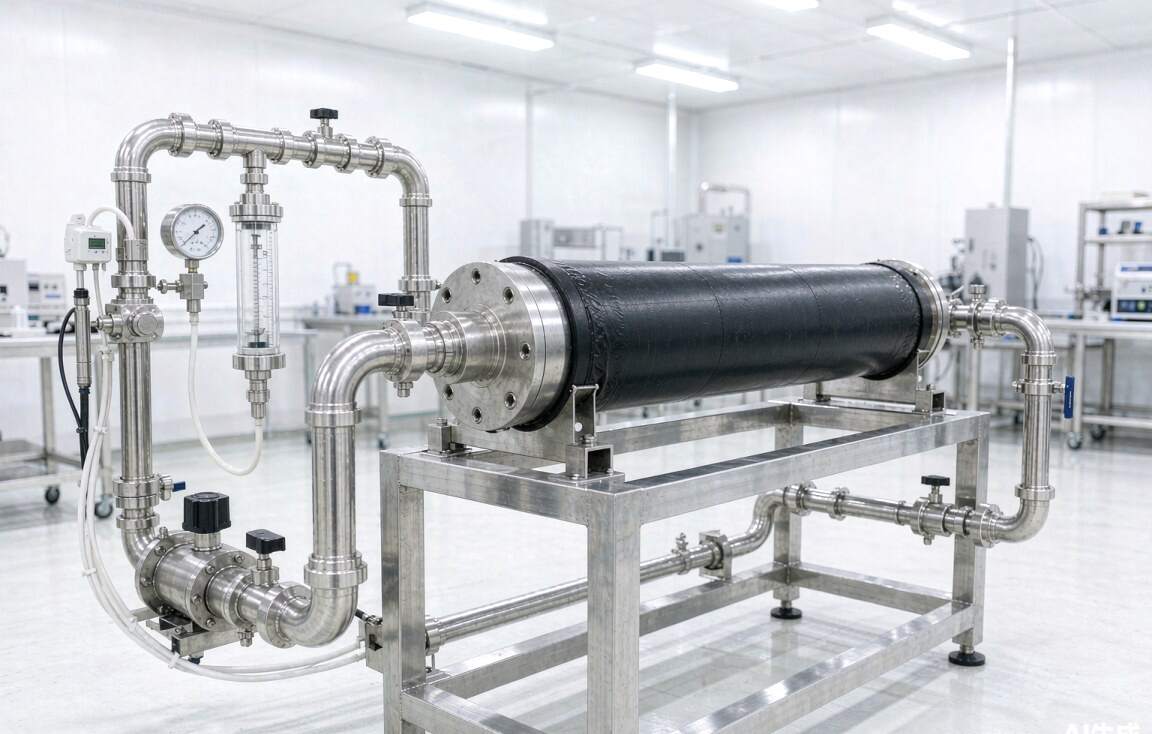
The subject was a submitted 8040 RO element (serial number 68812200702). Testing covered visual inspection and weighing, plus element performance testing under standard conditions. Methods followed GB/T 17378.4 (sodium chloride concentration) and GB/T 6908 and GB/T 17323 (conductivity), among others. Instrument accuracy: flow meter ±1%, conductivity meter ±1%, pressure gauge ±1.5%, thermometer resolution 0.1 °C.
Testing was conducted at 25.8 °C, pH 7.3 and feed pressure 15.36 bar: feed conductivity 3970 μS/cm, permeate conductivity 22.33 μS/cm, rejection 99.44%; feed flow 11.30 m³/h, permeate flow 1.72 m³/h (9079 GPD), recovery 15.22%. The element weighed 15.66 kg and its surface was clean with no attached contaminants.
- Client
- Yili Xintian Coal Chemical Co., Ltd.
- Testing institute
- Zhejiang Zheneng Technology Research Institute Co., Ltd. (Institute of Environmental and Chemical Technology)
- Report number
- ZERD-2024-R-80-021
- Report date
- March 2024
- Test subject
- 8040 RO membrane element (serial number 68812200702)
- Test items
- Visual inspection and weighing, salt rejection, permeate flow, recovery
- Test conditions
- 25.8 °C, pH 7.3, feed pressure 15.36 bar, feed conductivity 3970 μS/cm
- Conclusion
- Rejection 99.44%, permeate flow 1.72 m³/h (9079 GPD)
02
Process Design
System flow, design boundaries and key control points
01Sampling and sealing
→02Visual inspection and weighing
→03Loading onto the test bench
→04Steady operation under standard conditions
05Logging flow / conductivity / pressure
→06Calculating rejection and permeate flow
→07Issuing the test report
→Testing follows a single-variable, steady-condition principle: temperature, pressure and feed concentration are controlled, and readings are taken only after stable operation, avoiding transient data in the conclusion.
Standardized test conditions
At 25.8 °C, pH 7.3 and 15.36 bar, conditions are close to the membrane manufacturer's standard test point (25 °C, 1.55 MPa class), so measured values can be compared directly with nominal performance.
Synchronous multi-parameter logging
Feed, permeate and concentrate flow, feed and permeate conductivity and pressure are recorded together; rejection and recovery are calculated from the raw data, keeping the process traceable.
Visual inspection and weighing first
The element is first confirmed clean and free of attached contaminants (weight 15.66 kg) before performance testing, excluding mechanical damage as a factor in the results.
Engineering value of a third-party conclusion
Third-party data can be used to decide whether chemical cleaning or replacement is needed, and as technical evidence in membrane quality disputes or warranty claims.
03
Key Equipment & Membrane Configuration
Membrane models, loading arrangement and auxiliary equipment
| Item | Content |
|---|---|
| Testing institute | Zhejiang Zheneng Technology Research Institute, Institute of Environmental and Chemical Technology |
| Report number / date | ZERD-2024-R-80-021 / March 2024 |
| Test subject | 8040 RO membrane element (serial number 68812200702) |
| Test basis | GB/T 17378.4, GB/T 6908, GB/T 17323 and others |
| Main instruments | Flow meter (±1%), conductivity meter (±1%), pressure gauge (±1.5%), thermometer (0.1 °C) |
| Judgement method | Comparing measured rejection and permeate flow with nominal values |
Test methods follow the report's Table 3, Test Process Parameter Detection Indicators for RO Membrane Elements.
04
Operating & Acceptance Data
Field measurements versus contractual guarantee values
| Test item | Unit | Measured data |
|---|---|---|
| Temperature | °C | 25.8 |
| pH | — | 7.3 |
| Feed pressure | bar | 15.36 |
| Feed conductivity | μS/cm | 3970 |
| Permeate conductivity | μS/cm | 22.33 |
| Salt rejection | % | 99.44 |
| Feed flow | m³/h | 11.30 |
| Permeate flow | m³/h (GPD) | 1.72 (9079) |
| Recovery | % | 15.22 |
| Element weight | kg | 15.66 |
Conclusion: in this test the RO membrane achieved 99.44% salt rejection and permeate flow of 1.72 m³/h (9079 GPD). Results are standard-condition data for a single element; differences from actual system operating values are normal.
05
Project Results
Client acceptance conclusions and reusable engineering experience
✓
Rejection performance well maintained
Measured rejection of 99.44% at a feed of 3970 μS/cm shows the element retains a high desalination capability.
✓
Permeate flow with a traceable basis
Permeate flow of 1.72 m³/h (9079 GPD) can be compared directly with the element's nominal output to judge the extent of flux decline.
✓
Third-party report supports O&M decisions
The report provides independent, traceable technical evidence for choosing chemical cleaning or replacement timing and for warranty discussions.
✓
A replicable testing workflow
The complete flow of sampling – visual inspection and weighing – standard-condition testing – data calculation – report issuance can serve as a template for an annual membrane performance survey.