Coal Chemical · Zero Liquid Discharge & Wastewater Reuse
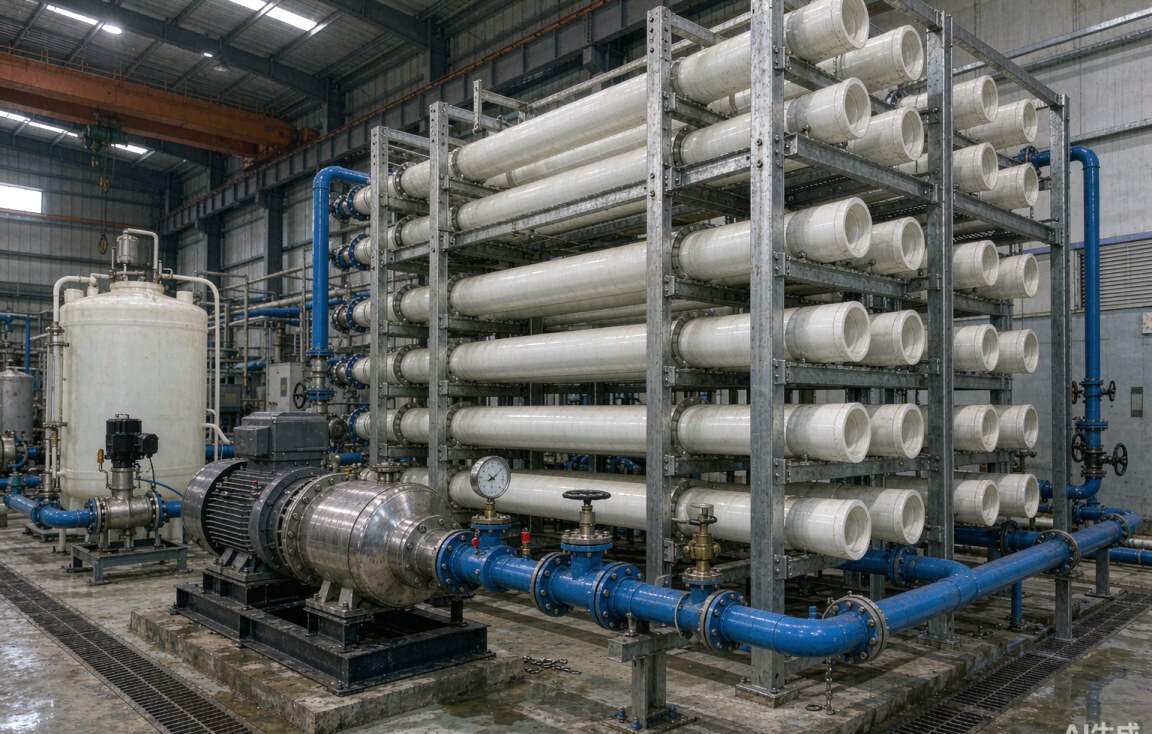
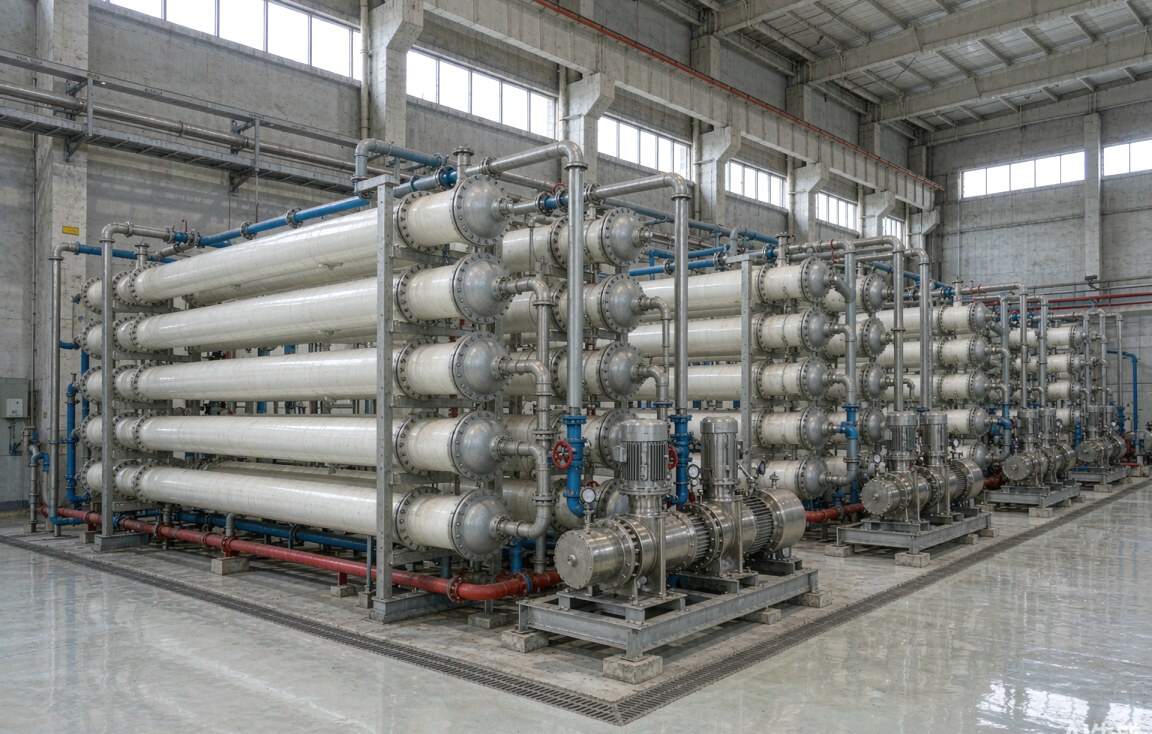
Xinjiang Qinghua Energy Group RO Membrane Replacement across Three Plant Areas
Membranes were replaced simultaneously in the chemical water, reclaimed water and high-salinity brine plant areas: 294 elements for chemical water, 168 per unit for reclaimed water, and 132 + 68 for brine, spanning feed conductivity from 390 to 18000 μS/cm.
Coal ChemicalZero Liquid DischargeFouling-Resistant MembraneInter-Stage Boosting
18000Max feed conductivity μS/cm
>57Brine recovery %
294Chemical water elements
20Days to install
01
Project Overview
Client, scale, feed water and project background
The water system at the Xinjiang Qinghua Energy Group coal chemical base comprises chemical water, reclaimed water reuse and high-salinity brine plant areas, responsible respectively for boiler make-up preparation, wastewater reuse and brine volume reduction. Feed salinity differs enormously across the three: about 390 μS/cm for chemical water, about 7000 μS/cm for reclaimed water, and up to 18000 μS/cm for the brine stream.
This project replaced RO elements in all three areas at once: 294 elements in the 4B RO of the chemical water unit (two stages, 32:17); the 2B and 3#-4B RO units of the reclaimed water area with 168 elements per unit (two stages, 18:10); and one set of elements in the brine unit (132 in stage one, 68 in stage two) with inter-stage boosting retained.
The bid was won on 28 April 2024 and the contract signed on 30 April; work started on site on 1 July and all installation was completed on 20 July, with acceptance organized on 21 July. High-rejection membranes and fouling-resistant membranes were selected for the different water qualities, with differentiated recovery and rejection guarantees.
- Client
- Xinjiang Qinghua Energy Group Co., Ltd.
- Location
- Qinghua water treatment site, Yining County, Ili Prefecture, Xinjiang
- Project type
- RO element replacement across three plant areas
- System scale
- Chemical water 294 / reclaimed 168 per unit / brine 132 + 68
- Feed water
- Chemical water: external supply; Reclaimed: park reclaimed water; Brine: membrane concentrate
- Product water use
- Boiler make-up water, wastewater reuse, brine volume reduction (ZLD)
- Membrane elements
- QC-HS-8040 / SPRO-8040FR (8040, 37.2 m², composite polyamide)
- Acceptance date
- 21 July 2024
02
Process Design
System flow, design boundaries and key control points
1. Chemical water unit
294 elements replaced in the 4B RO, two stages 32:17, treated flow ≥220 m³/h
01External supply water
→02Multi-media filtration
→03Ultrafiltration
→04Cartridge filter
05High-pressure pump
→06First-pass RO
→07Second-pass RO
→08Demineralized tank
Recovery >75%; salt rejection ≥98% within one year and ≥96% within three years.
2. Reclaimed water unit
2B and 3#-4B RO replaced, 168 elements per unit, two stages 18:10
01Reclaimed water
→02Clarification / filtration
→03Ultrafiltration
→04Cartridge filter
05High-pressure pump
→06First-pass RO
→07Reuse basin
→Treated flow ≥200 m³/h, permeate ≥130 m³/h, feed pressure <1.4 MPa, recovery >60%.
3. High-salinity brine unit
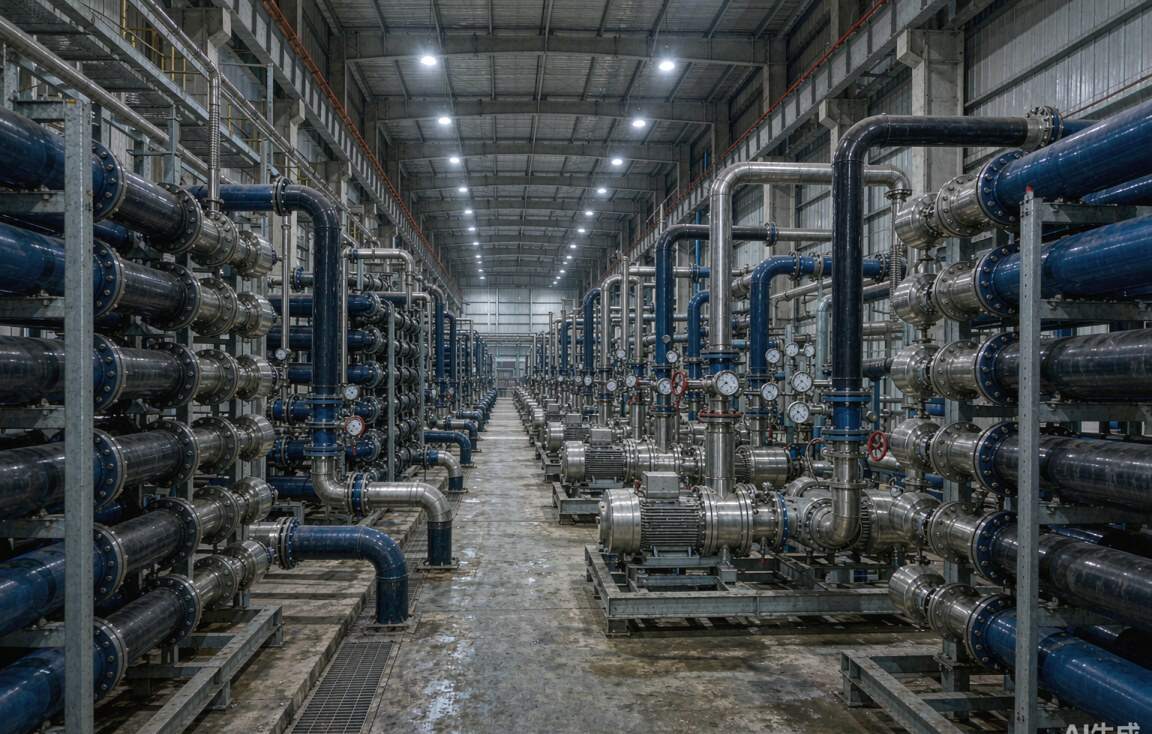
One set of elements replaced (132 in stage one, 68 in stage two), inter-stage boosting retained
01High-salinity brine
→02Equalization basin
→03Clarification / filtration
→04Ultrafiltration
05Cartridge filter
→06High-pressure pump
→07Stage-one RO
→08Inter-stage boosting
09Stage-two RO
→→→Treated flow ≥175 m³/h, stage-one permeate ≥90 m³/h and stage-two ≥40 m³/h; high-pressure pump outlet <1.8 MPa, booster outlet <2.0 MPa, recovery >57%.
Membrane selection by water quality zone
High-rejection polyamide membranes are used for chemical water and brine, while large-flux fouling-resistant membranes serve the reclaimed water train — membrane selection matched to water quality rather than one model for the whole project.
Two-stage arrangement with inter-stage boosting
The brine system retains inter-stage boosting to make up the driving force in stage two, so that even at 18000 μS/cm osmotic pressure the unit still holds the 90 / 40 m³/h split between stages.
Graded recovery control
Recovery is set at >75% for chemical water, >60% for reclaimed water and >57% for brine. Higher recovery means higher scaling risk, so graded targets balance membrane life against volume reduction.
Rejection guaranteed by service year
Two-tier rejection guarantees (one year / three years) are given for each system type (98/96, 97/94, 96/92), bringing performance decay into the assessable scope.
03
Key Equipment & Membrane Configuration
Membrane models, loading arrangement and auxiliary equipment
| Plant area | Membrane configuration | Arrangement | Treated flow | Permeate requirement | Recovery | Rejection guarantee |
|---|---|---|---|---|---|---|
| Chemical water | 4B RO, 294 elements | Two stages 32:17 | ≥220 m³/h | — | >75% | ≥98% in 1 yr / ≥96% in 3 yrs |
| Reclaimed water | 2B, 3#-4B, 168 per unit | Two stages 18:10 | ≥200 m³/h | ≥130 m³/h | >60% | ≥97% in 1 yr / ≥94% in 3 yrs |
| High-salinity brine | One set (132 stage one / 68 stage two) | Two stages + inter-stage boosting | ≥175 m³/h | Stage one ≥90, stage two ≥40 m³/h | >57% | ≥96% in 1 yr / ≥92% in 3 yrs |
Each element provides 37.2 m² of effective area in 8040 size, made of composite polyamide; maximum operating pH range 1–13, element flux ≥15 lmh.
04
Operating & Acceptance Data
Field measurements versus contractual guarantee values
| Feed system | Conductivity μS/cm | Hardness mg/L | Other key indicators | Design product water quality |
|---|---|---|---|---|
| Chemical water | 390 | — | TDS 276 mg/L, suspended solids 75 mg/L, CODcr 20.1 mg/L | Rejection ≥98% in 1 yr |
| Reclaimed water | 7000 | 1000 | Alkalinity 800, chloride 1000, turbidity 20 NTU, CODcr 200 | Rejection ≥97% in 1 yr |
| High-salinity brine | 18000 | 1700 | Alkalinity 1400, calcium 700, chloride 1800, CODcr 600 | Rejection ≥96% in 1 yr |
Brine feed hardness is designed at 1700 mg/L (original design control value 150 mg/L); scaling is suppressed in operation through dosing and recovery control. All three systems are designed for 24-hour continuous operation.
05
Project Results
Client acceptance conclusions and reusable engineering experience
✓
Three areas accepted in a single campaign
Chemical water, reclaimed water and brine were all re-membraned within one shutdown window: completed on 20 July and accepted on 21 July.
✓
Covering the widest water quality span
Stable permeate production was achieved across feed conditions from 390 to 18000 μS/cm, validating the adaptability of the membrane selection and arrangement to very different water qualities.
✓
Supporting the zero liquid discharge target
The brine system runs stably at above 57% recovery, reducing the load on downstream evaporation and crystallization — a critical link in the ZLD chain.
✓
A graded guarantee system
Two-tier one-year / three-year rejection commitments replace a single indicator, providing a reference acceptance basis for comparable coal chemical projects.