Refining · Wastewater Reuse & Demineralization
Sinopec Maoming Branch Purified Water Demineralization RO Membrane Replacement
Fed with circulating water blowdown, regenerated acid/alkali wastewater and unit return water, the two RO systems deliver 70 m³/h per unit at 82 μS/cm permeate conductivity after replacement, with acceptance completed in July 2025.
Petroleum RefiningWastewater ReuseSPRO Membrane24 h Intermittent Operation
70Permeate per unit m³/h
82Permeate conductivity μS/cm
0.72Feed pressure MPa
400UF permeate m³/h
01
Project Overview
Client, scale, feed water and project background
The purified water demineralization unit in the chemical operations area of Sinopec Maoming Branch's water department produces demineralized water for the ethylene complex. Its feed is a mixture of circulating water blowdown, regenerated acid/alkali wastewater and unit return water — a typical refinery wastewater reuse duty with large quality swings and high organic and microbiological risk.
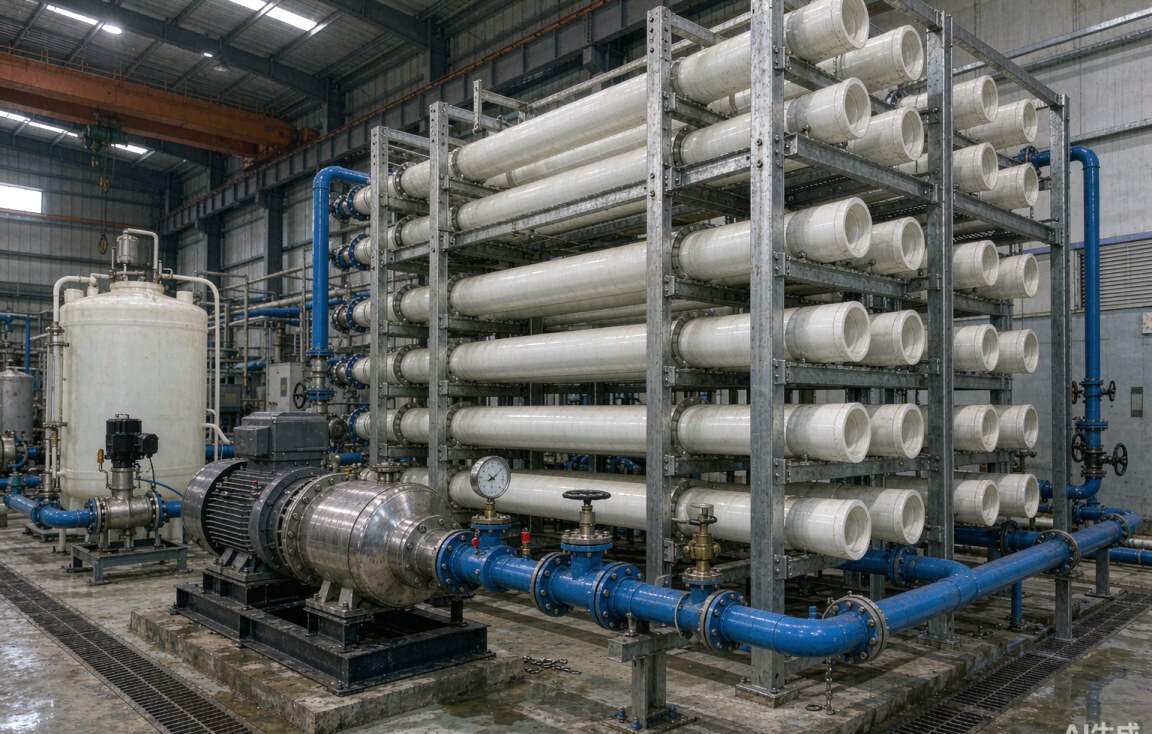
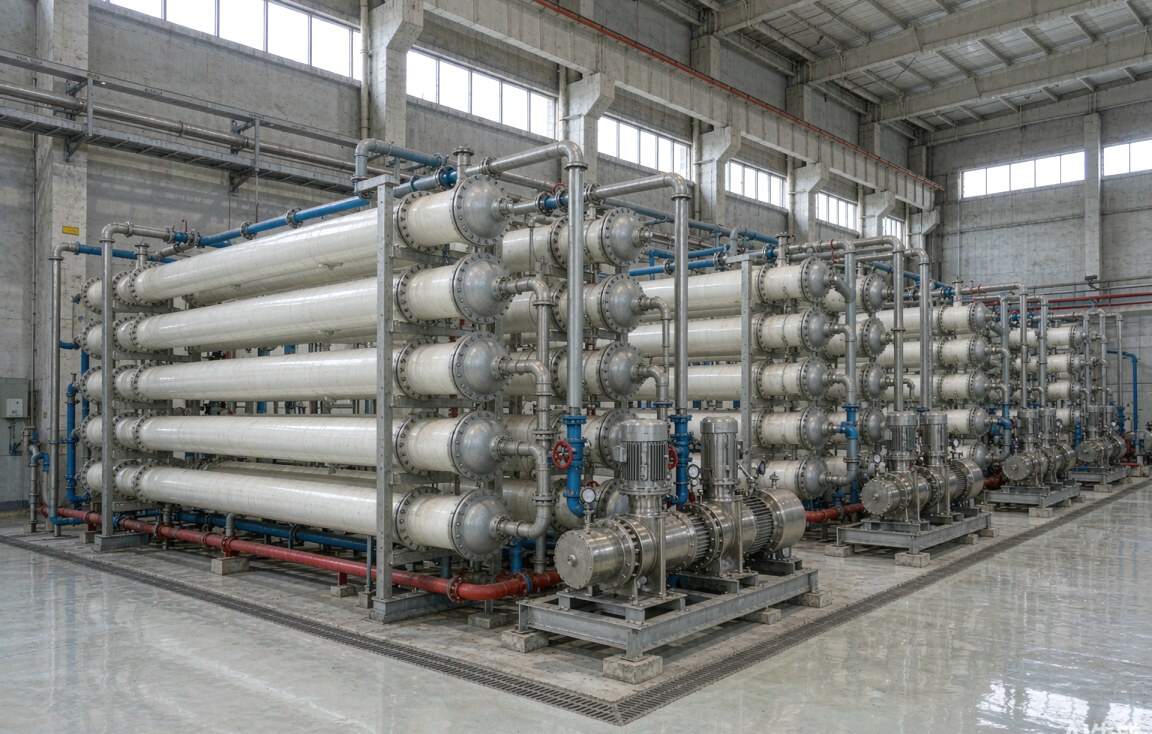
The process is cartridge filter → ultrafiltration → clean water pump → precision filter → high-pressure pump → RO → permeate tank → users. The UF unit produces 400 m³/h and RO permeate is designed at 240 m³/h × 2 trains. This project replaced the elements in both RO trains with SPRO-10FR membranes.
Elements were installed on 17 April 2025 and completed on 25 April, with acceptance organized on 12 July. Train A operating data: feed pressure 0.72 MPa, concentrate pressure 0.59 MPa, permeate flow 70 m³/h, permeate conductivity 82 μS/cm, concentrate flow 51 m³/h. The unit runs intermittently on a 24-hour cycle, matching the intermittent water demand of the refinery.
- Client
- Sinopec Maoming Branch, Water Department, Chemical Operations Area
- Location
- Ethylene complex, Maoming High-tech Zone, Guangdong
- Project type
- RO membrane replacement at the purified water demineralization unit (2 trains)
- System scale
- UF permeate 400 m³/h; RO permeate 240 m³/h × 2 trains
- Feed water
- Circulating water blowdown, regenerated acid/alkali wastewater, unit return water
- Product water use
- Plant demineralized water / process water
- Membrane elements
- SPRO-10FR
- Acceptance date
- 12 July 2025
02
Process Design
System flow, design boundaries and key control points
01Circulating blowdown / regenerated wastewater / unit return
→02Cartridge filter
→03Ultrafiltration 400 m³/h
→04Clean water pump
05Precision filter
→06High-pressure pump
→07Reverse osmosis
→08Permeate tank
09Users
→→→The upstream UF carries the main fouling load while the precision filter serves as the final RO guard; fluctuations in the mixed feed are absorbed by UF permeate buffering and dosing adjustment.
Managing a multi-source mixed feed
Circulating water blowdown, regenerated acid/alkali wastewater and unit return water are blended in proportion, requiring pH and residual chlorine control to avoid membrane oxidation and biofouling.
UF as the core barrier
The 400 m³/h UF keeps SDI and turbidity within element limits, which is decisive for stable operation of a refinery wastewater reuse system.
Adapting to intermittent operation
Under 24-hour intermittent operation, flushing and displacement are strictly executed at start-up and shutdown to limit concentrate-side scaling and microbial growth during outages.
Independent assessment per train
Trains A and B are metered separately for permeate flow, conductivity and differential pressure, so a decline in one train cannot be masked by the other.
03
Key Equipment & Membrane Configuration
Membrane models, loading arrangement and auxiliary equipment
| Equipment / Material | Specification | Quantity | Remarks |
|---|---|---|---|
| RO membrane elements | SPRO-10FR | Supplied for 2 trains | Fouling resistant |
| Ultrafiltration unit | 400 m³/h permeate | 1 | RO pretreatment |
| Cartridge / precision filters | Matched to the system | 1 each | Final protection |
| High-pressure pumps | — | 2 | Feed pressure 0.72 MPa |
| Permeate tank | — | 1 | Product water buffering |
Equipment specifications are taken from the process and system description in the acceptance report; refer to as-built documentation for exact models and quantities.
04
Operating & Acceptance Data
Field measurements versus contractual guarantee values
| Item | Operating data | Notes |
|---|---|---|
| Feed pressure | 0.72 MPa | Train A |
| Concentrate pressure | 0.59 MPa | Train A |
| Permeate flow | 70 m³/h | Train A (train B to be added) |
| Concentrate flow | 51 m³/h | Train A |
| Permeate conductivity | 82 μS/cm | Corresponding to reuse water quality requirement |
| Operating mode | 24 h intermittent | Matches intermittent unit demand |
Design feed temperature is 25 °C, with actual operating temperature of 25–35 °C. The feed is industrial wastewater, so residual chlorine and COD swings must be watched for their effect on membrane life.
05
Project Results
Client acceptance conclusions and reusable engineering experience
✓
Permeate output and quality restored together
Train A delivers 70 m³/h at 82 μS/cm, satisfying the plant demineralized water system's requirement for RO permeate.
✓
Adapted to intermittent refinery demand
Under 24-hour intermittent operation the membrane system starts and stops stably, with no noticeable permeate decline.
✓
Closing the wastewater reuse loop
Circulating water blowdown and regenerated wastewater return to the demineralization system after treatment, reducing fresh water intake.
✓
Operating experience for refinery reuse
A flushing and dosing strategy has been established for multi-source blending, UF + RO and intermittent operation.