Municipal Water Supply · Nanofiltration Polishing
Makit County Water Treatment Plant Nanofiltration System, Xinjiang
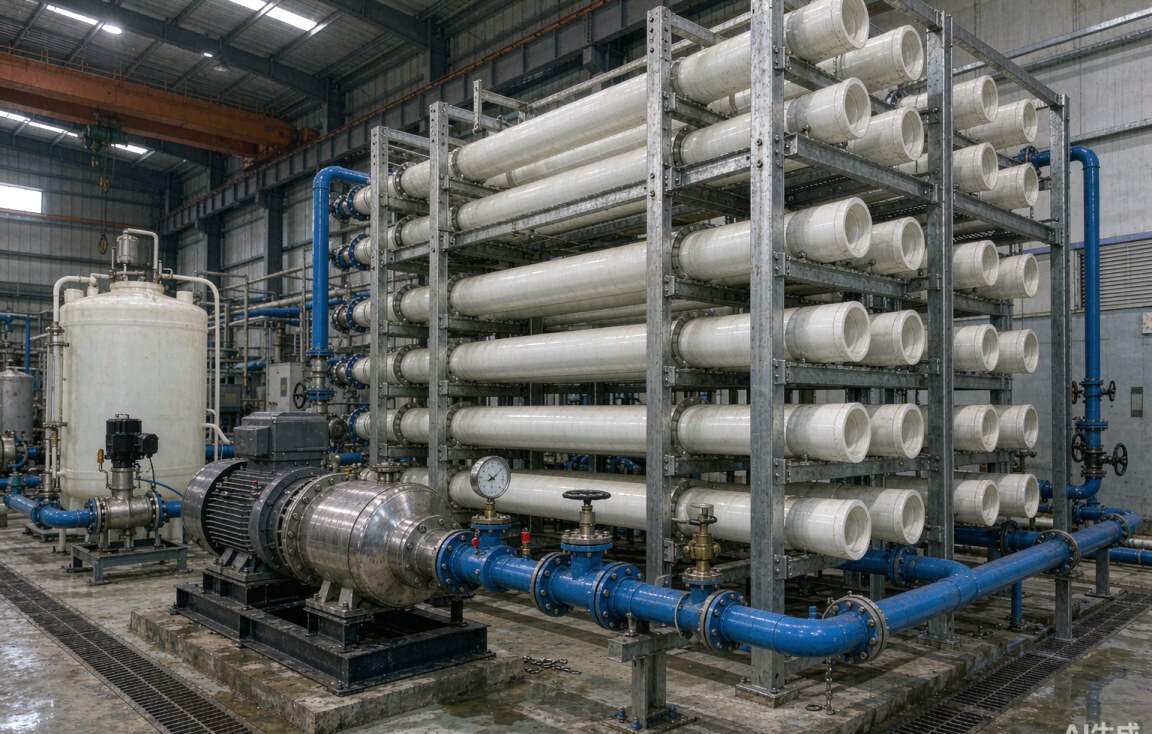
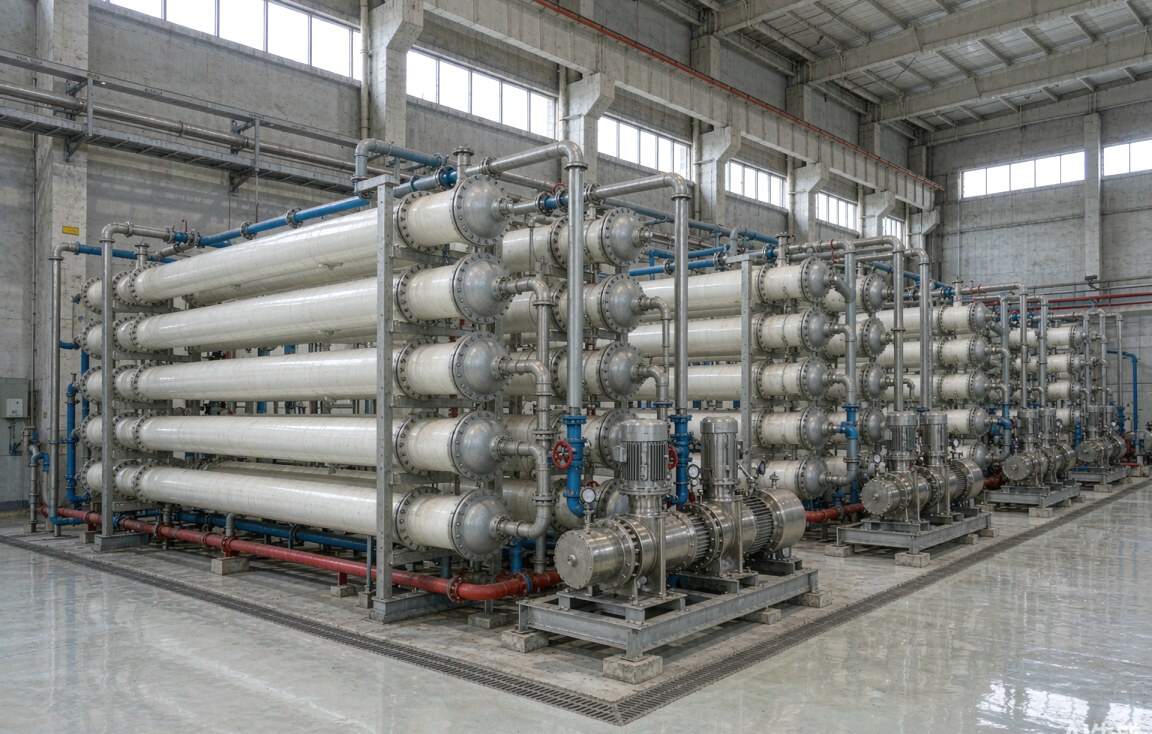
Eight nanofiltration units running in parallel turn high-salinity, high-hardness raw water into compliant drinking water. Each unit delivers 91–107 m³/h, with permeate conductivity held steady at 12–21 μS/cm.
Municipal Drinking WaterNanofiltration (NF)Brackish Water Desalination8 Units in Parallel
700–750Feed conductivity μS/cm
12–21Permeate conductivity μS/cm
≈97Salt rejection %
8NF units
01
Project Overview
Client, scale, feed water and project background
Makit County lies on the southwestern edge of the Taklamakan Desert, where both surface water and groundwater are generally high in salinity and hardness. Conventional coagulation–sedimentation plus filtration cannot reliably meet drinking-water requirements for taste and total dissolved solids. The plant therefore added a nanofiltration polishing stage downstream of the existing pretreatment, with eight NF units in parallel carrying the main desalination duty.
Nexympure supplied the nanofiltration membrane elements and the associated technical services; installation, commissioning and acceptance were completed in August 2023. All eight units were started up together under identical feed conditions, and pressure, flow and permeate conductivity were logged unit by unit throughout acceptance. Permeate output and product water quality met the design requirements on every unit, and the client signed off with a satisfactory rating.
The project confirmed the stability and economy of an ultrafiltration + nanofiltration route for municipal supply under the high-hardness, high-salinity source conditions of northwest China: divalent ions and part of the monovalent salts are removed while an appropriate mineral content is retained, giving noticeably better taste than a pure reverse-osmosis scheme.
- Client
- Makit County Water Treatment Plant
- Location
- Makit County, Kashgar Prefecture, Xinjiang
- Project type
- New nanofiltration stage for advanced treatment
- System scale
- 8 NF units, 91–107 m³/h permeate each
- Feed water
- Raw water reservoir, pretreated by multi-media filtration and ultrafiltration
- Product water use
- Drinking water / municipal supply
- Membrane elements
- Nanofiltration composite elements (fouling resistant)
- Acceptance date
- 19 August 2023
02
Process Design
System flow, design boundaries and key control points
01Raw water reservoir
→02Multi-media (high-density) filter
→03Ultrafiltration
→04Nanofiltration
→05Clear water tank
→06Municipal distribution network
Raw water first passes through the multi-media filter to reduce turbidity and part of the hardness; ultrafiltration then acts as the protective barrier ahead of the NF units. NF permeate is disinfected in the clear water tank before entering the distribution network.
Multi-barrier protection of the membrane surface
Multi-media filtration plus ultrafiltration form a dual pretreatment train that controls turbidity and colloids reaching the NF units, preventing rapid fouling — the prerequisite for stable long-term parallel operation of all eight units.
Flexible configuration of eight parallel units
Each unit starts and stops independently, so the number of units in service can follow seasonal demand, avoiding off-design flux and wasted energy at low load.
Low-pressure operation to control energy use
Feed pressure is held at 0.66–0.73 MPa with the high-pressure pump running at 35 Hz, keeping specific energy consumption low while meeting the output requirement.
Mineral-retaining nanofiltration characteristics
NF selectively removes divalent ions: permeate meets the dissolved-solids limit while retaining part of the beneficial mineral content, making it well suited to direct use as drinking water.
03
Key Equipment & Membrane Configuration
Membrane models, loading arrangement and auxiliary equipment
| Equipment / Material | Specification | Quantity | Remarks |
|---|---|---|---|
| NF membrane elements | Composite NF membrane, 8040 size | Supplied for 8 units | Fouling resistant |
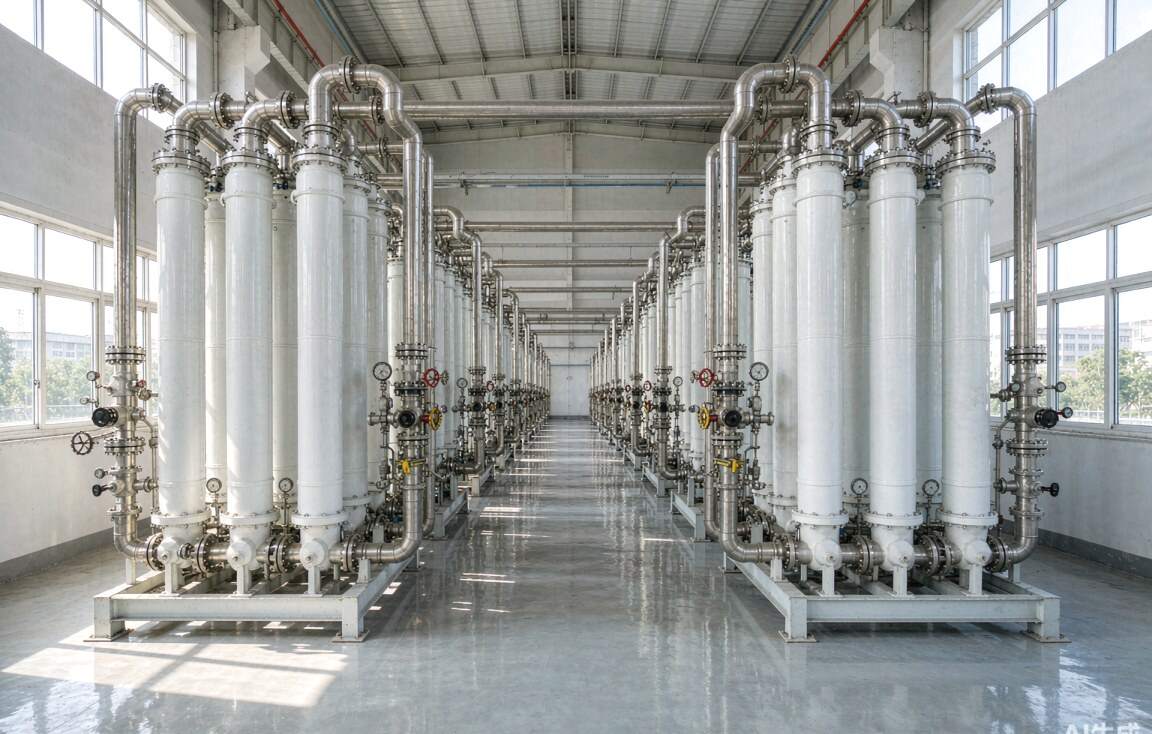
| Membrane pressure vessels | Vertical installation, multi-element | Arranged across 8 units | Stainless-steel piping |
| High-pressure pump | VFD controlled, running at 35 Hz | 1 per unit | Feed pressure 0.66–0.73 MPa |
| Pretreatment | Multi-media (high-density) filter + ultrafiltration | Matched | Controls feed turbidity |
| Instrumentation | Pressure gauges, flow meters, conductivity meters | Complete set | Parameters logged per unit |
Membrane element and auxiliary equipment quantities reflect the actual loading of the eight units on site; refer to the as-built documentation for final figures.
04
Operating & Acceptance Data
Field measurements versus contractual guarantee values
| Unit | Feed pressure MPa | Inter-stage pressure MPa | Concentrate pressure MPa | Permeate flow m³/h | Concentrate flow m³/h | Permeate conductivity μS/cm |
|---|---|---|---|---|---|---|
| 1# | 0.67 | 0.53 | 0.38 | 100.6 | 45.9 | 15.3 |
| 2# | 0.70 | 0.52 | 0.40 | 105.2 | 44.8 | 19.3 |
| 3# | 0.66 | 0.53 | 0.41 | 101.1 | 46.5 | 17.4 |
| 4# | 0.71 | 0.57 | 0.39 | 107.0 | 45.8 | 16.2 |
| 5# | 0.70 | 0.55 | 0.38 | 105.5 | 46.8 | 12.2 |
| 6# | 0.73 | 0.57 | 0.41 | 103.2 | 44.6 | 20.3 |
| 7# | 0.71 | 0.56 | 0.40 | 103.3 | 46.0 | 17.8 |
| 8# | 0.72 | 0.55 | 0.40 | 105.0 | 47.0 | 21.0 |
Feed conductivity 700–750 μS/cm, feed temperature 15–24 °C. Permeate output across the eight units was 100.6–107.0 m³/h with permeate conductivity of 12.2–21.0 μS/cm, equivalent to roughly 97% salt rejection. Unit-to-unit deviation stayed within ±3%, indicating consistent flow distribution and membrane loading.
05
Project Results
Client acceptance conclusions and reusable engineering experience
✓
All units passed acceptance on the first attempt
Permeate flow and conductivity met the design targets on all eight units; the client recorded a satisfactory opinion and signed off on 19 August 2023.
✓
Consistently compliant product water
Permeate conductivity has stayed well below 35 μS/cm (12–21 μS/cm measured at acceptance), far better than the dissolved-solids requirement for drinking water.
✓
Tight consistency of operating parameters
Feed pressure of 0.66–0.73 MPa and small permeate-flow deviations across the eight units show that the parallel flow distribution design is sound, simplifying unified O&M and cleaning.
✓
A replicable municipal NF scheme
The complete multi-media + UF + NF configuration experience gained here can be transferred directly to other plants in southern Xinjiang treating high-hardness, high-salinity source water.